
AI on the Board
Keeping humans at the center of the AI revolution in education.
Edition #39 | May 21, 2026
Policy Is Running. AI Is Sprinting. Guess Who Is Winning.
Policymakers Are Playing Catch-Up With AI. And AI Is Not Slowing Down.
Institute for Family Studies
Summary
The US Department of Education finalized its grantmaking priorities for advancing AI in education on April 13, responding to over 300 public comments. The final language added three new priorities and made two meaningful edits: AI integration in K-12 must now be “age-appropriate” and pursued in “ethical” ways. The Institute for Family Studies had argued that the original proposal would impose untested technologies on schools without adequate research, parental input, or clarity on what “appropriate” AI use actually means. While welcoming the changes, critics note that the finalized language was written for an earlier era of AI tools and may already be out of date as agentic AI systems that act autonomously begin entering the education space.
My Key Takeaway
The US Department of Education recently finalized its grantmaking priorities for AI in education, adding language requiring that AI integration be “age-appropriate” and “ethical.” That is a step in the right direction. But here is the uncomfortable truth underneath this story: by the time these guidelines were written, reviewed, commented on, revised, and finalized, the technology they are describing had already moved on.
That is the real issue here. It is not whether the Department of Education is trying. It is that the pace of AI development and the pace of policy development are completely out of sync. Policymakers are writing rules for a version of AI that existed a year ago, maybe two years ago. The tools in classrooms and on students’ phones today are already different. And the next generation of AI, systems that do not just answer questions but act autonomously over extended periods, is already on its way.
I keep thinking about the processor race I grew up with. Every six months there was a new chip: the 386, the 486, the Pentium, and on and on. And then somewhere around ten years ago it started to plateau, at least for a while. AI is not plateauing. It is building on itself, getting more capable, and compressing the timeline between breakthroughs.
I do not have a clean solution. Maybe we need the actual heads of these AI companies sitting at the policy table, not just their lobbyists. Maybe we need faster, more adaptive regulatory frameworks that can update as the technology updates. What I do know is that playing catch-up is never a winning strategy. You have to find a way to get ahead of it, or at least run alongside it. Right now, we are not doing either.
What do you think: is it even possible for policy to keep pace with AI? Let us know in the comments.
Parents Are a Missing Piece in the AI and Education Conversation
EdSource
Summary
Two computer science educators and parents argue that when parents understand AI and how it works, they become far better advocates for the right kind of technology in their children’s schools. Writing from their experience working with families in California’s Central Valley, they describe parents from low-income communities who had no prior knowledge of AI but are now, after participating in community workshops, drafting letters to school boards demanding computer science and AI literacy pathways. Their central argument is that AI literacy should not be left to schools alone: parents who understand the technology can push for equity, ask better questions, and help ensure their children are prepared for a world where AI is foundational.
My Key Takeaway
This article makes a case I believe in strongly: parents need to be part of the AI conversation in education, not just passengers in it.
The piece focuses on families in California’s Central Valley, many from low-income, Spanish-speaking communities where parents have had little exposure to or knowledge of technology education. Through a program called Plugging into Power, these parents are being brought into workshops where they learn what AI actually is, how it works, and why it matters for their children’s futures. And something shifts. Parents who had never heard of AI are now drafting letters to school boards and superintendents demanding computer science and AI literacy pathways for their kids.
That is powerful. And it speaks to something I have been thinking about since COVID. One of the few genuine positives that came out of that period was that parents woke up. They started seeing, really seeing, what was happening in their children’s schools. They felt a sense of agency in their kids’ education that many had never felt before. That is something worth building on.
Here is the equity dimension that matters: in wealthier communities, parents already know what computer science and AI literacy are, and they are already demanding them. Their children are getting those pathways because someone is pushing for them. In lower-income communities, that push is not happening, not because parents do not care, but because no one has brought them into the conversation yet. Closing that gap in parental knowledge might be just as important as any curriculum change or district policy.
Education starts at home. Parents who understand AI are better equipped to guide their children, ask the right questions, and advocate for the right things. That is not a small thing.
What role do you think parents should play in shaping AI policy in schools? Let us know in the comments.
Same School, Different Worlds. AI Consistency Is Still a Long Way Off.
eSchool News
Summary
Even within the same school or district, AI can mean something completely different depending on which classroom you walk into. Some teachers use it daily for differentiation, translation, feedback, and lesson planning. Others have never touched it. Research from a University of Washington study of 22 teachers in a Colorado district going all-in on AI found that even in a supportive environment, usage was wildly inconsistent. The authors argue that without shared language, sustained professional learning, and teacher-led communities of practice, AI integration will remain fragmented, inequitable, and impossible to evaluate at scale.
My Key Takeaway
We have talked about this before, but this week’s article puts it in sharp relief: AI in education right now means something completely different depending on which classroom door you walk through.
In one room, a teacher is using AI to translate materials into four languages, differentiating instruction for a multilingual classroom in ways that simply were not possible before. In the room next door, AI has never been touched. Down the hall, a teacher is using it in a completely different way, with no coordination, no shared framework, and no one comparing notes.
This is the Wild West, and the problem is not just inconsistency. It is inequity. Students in the same building are getting fundamentally different educational experiences based on whether their teacher happens to be an early adopter or a skeptic. That is not a teacher problem. That is a systems problem.
What is missing is what we have talked about in this newsletter for weeks: not more one-off professional development sessions, not more policies handed down from above, but genuine teacher learning communities. Groups of educators who meet regularly, share what is actually working, practice together, fail together, and grow together. That is what makes professional learning stick. That is what eventually produces real consistency across a school and a district.
Right now, teachers are largely being left on their own to figure this out. Some are rising to it. Many are overwhelmed. And the students caught in between are the ones paying the price for a system that has not caught up yet.
What would it take to build real teacher learning communities around AI in your school or district? Let us know in the comments.
This Is What AI in Education Should Look Like
University at Buffalo
Summary
The National AI Institute for Exceptional Education at the University at Buffalo, funded by a five-year $20 million grant from the NSF and the Department of Education, showcased its progress during a formal site visit from federal officials. The Institute, a coalition of nine universities including Cornell, Penn State, Stanford, and the University of Washington, is building AI tools to address a critical gap: 3.4 million children in the US need speech and language services, but there are not nearly enough speech-language pathologists to serve them. Tools in development include an AI Screener that passively monitors children in childcare settings and has already achieved 90% accuracy in identifying language delay risk, and PaiCoach, which gives parents timestamped feedback on their interactions with children during reading activities.
My Key Takeaway
In a newsletter that spends a lot of time on the challenges and risks of AI in education, this article is a genuine bright spot. And I want to take a moment with it.
A coalition of nine universities pooled their research expertise to tackle a specific, urgent, and under-resourced problem: 3.4 million children in the US need speech and language services, and there simply are not enough speech-language pathologists to serve them. So they built the tools themselves. They created their own datasets from scratch, collecting thousands of children’s handwriting samples and hundreds of hours of video of parents reading to their children, because that data did not exist at sufficient scale. They built a screening tool that has achieved 90% accuracy in identifying language delay risk in children as young as preschool age.
This speaks to me personally. I spent years as a special education teacher, and I saw firsthand what happens when a child with reading or language challenges does not get help early enough. The gap widens. The frustration builds. The confidence erodes. Early identification and early intervention are not just helpful. They are the difference.
And as someone who taught in Jewish schools where reading is not just an academic skill but a religious and cultural one, the stakes of getting this right feel even higher. Reading connects children to their heritage, their community, and their identity. When a child struggles and does not get support, the cost goes far beyond grades.
This is the version of AI in education I want to see more of. Not chatbots generating essays. Not flashy tools with no research behind them. Careful, collaborative, human-centered work that uses AI to do something that genuinely could not be done without it. More of this, please.
What do you think about AI being used specifically for students with learning differences? We would love to hear your thoughts in the comments.
Using AI to Level the Playing Field. A Plan Worth Taking Seriously.
Chicago Tribune / Paul Vallas
Summary
Paul Vallas, former CEO of Chicago Public Schools and former budget director for the city, argues that the crisis of academic underachievement in the US is not caused by a lack of knowledge about what works but by an inability to scale it. He identifies five pillars common to high-performing schools: strong early childhood education, data-driven curriculum, continuous data-driven interventions, leadership-driven accountability, and maximizing instructional time on task. His argument is that AI can deliver these pillars at scale to children in under-resourced schools who currently have no access to them, regardless of zip code. He is explicit that AI is not intended to replace teachers but to augment them, and that implementation must include equity, privacy, and human-centered safeguards.
My Key Takeaway
For the final article this week, I am reaching back into my Chicago days. I have a vague memory of Paul Vallas. He ran for mayor of Chicago, which is already a remarkable thing in that city’s political landscape. He was CEO of Chicago Public Schools and budget director for the city. He is a conservative voice, and I want to be transparent about that framing. But he makes points here that I think transcend politics, and they deserve to be heard.
His central argument is that the crisis of academic underachievement in the US is not caused by a lack of knowledge about what works. We know what works. High-performing schools share a common set of qualities: strong early childhood education, data-driven curriculum, continuous intervention systems, instructional leadership, and maximizing time on task. The problem is that those qualities are almost impossible to scale through traditional means alone. They require resources, expertise, and infrastructure that are simply not evenly distributed.
His argument is that AI can change that equation. AI can deliver the structural support found in the best school districts to children who have never had access to it, regardless of zip code. And the children who most need this are the ones currently being left behind, not because anyone wants that, but because the resources are not there.
I want to be honest: this is a plan, not a proven system. And the politics around education funding and equity are real and complicated. Children should never be collateral damage in political fights, and too often they are. But what I appreciate about this piece is that it does not just identify the problem. It proposes a framework. And that framework, early intervention, data systems, coaching, continuous support, is consistent with almost everything we have discussed in this newsletter over the last 39 editions.
Let us put the politics aside and ask the real question: can AI be the great equalizer in education? And if so, what would it actually take to get there? Leave your thoughts in the comments, and thank you for another great week. Have a wonderful weekend.
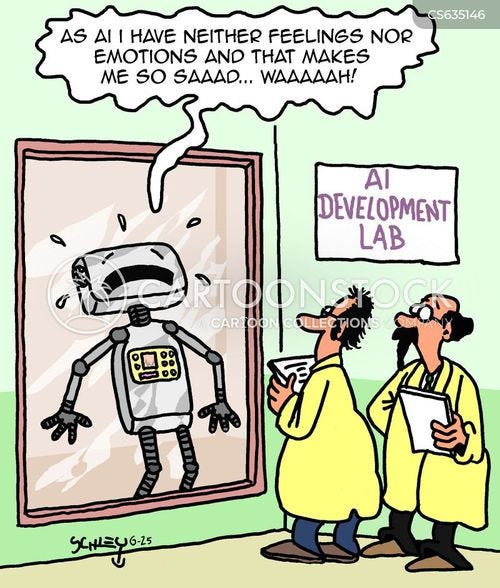
This Week’s Comic 😄
🤔 This Week’s Question
We talk a lot about AI in well-resourced schools and districts. But what about the students who are falling furthest behind? What would it actually take to make AI work for every child, not just the ones who already have advantages?